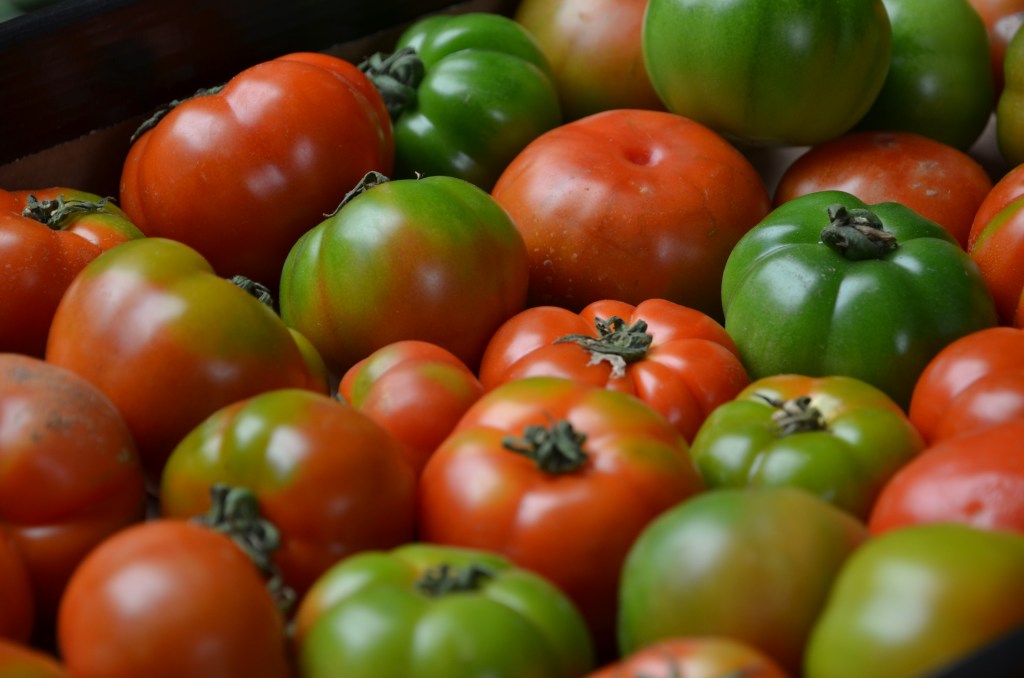
Tomatoes at various ripening stages (this image is in the public domain).
Not long ago, I took a short break from my MSc project to go back home and see my family for Easter. This meant using up all the food in my fridge before leaving, and I cooked up some pretty eclectic meals as a result. First step: pulling out half a punnet of tomatoes I’d relegated to the back of the vegetable shelf for a makeshift pasta sauce.
This week of frugal cooking coincided wonderfully with the publication of a paper by Qingfeng Niu and colleagues which investigated the role of a pair of transcription factors involved in tomato ripening.

Transcription factors are proteins that can fine-tune gene expression upon binding to specific sites throughout the genome. Upon binding, they often recruit other proteins to the site to help, such as chromatin remodellers, which may physically “open” up the gene to allow increased transcription.
It takes two
The involvement of the two chosen transcription factors, RIN and FUL1, in tomato ripening is well-established – mutations in the RIN* gene were known to delay ripening as far back as the 1970s. What was not yet well-characterised, however, was whether their activity was modulated by DNA methylation, tiny chemical markers found across the genome which physically block transcription factors from binding.
The main question was: does changing levels of DNA methylation have a knock-on effect on RIN activity, and does this alter tomato ripening?
To this end, DML2 was a major investigative target for the authors – DML2 is a demethylase, which sweeps methylation markers off genetic promoter sequences, and permits increased transcription at these sites.
By generating plants where DML2 and DML3** were mutated (still present in the cells, just not functional) the authors demonstrated that the promoter regions – where transcription factor binding sites are often found*** – of the RIN and FUL1 genes became hypermethylated. RIN and FUL1 expression fell, resulting in green tomatoes for longer.****
Lower expression doesn’t mean lower activity
Gene expression of RIN and FUL1 may have decreased, but did their protein products still bind their docking sites across the genome?
Indeed, RIN binding dropped in DML2-3 mutant plants, and this was correlated to (though not necessarily caused by) increased methylation at RIN binding sites. These were termed “blocked” sites by the authors. Intriguingly, RIN was most effectively blocked when methylation was found within 100 base pairs (the individual letters A, T, C, and G that make up the DNA sequence) of a RIN binding site – this is a very restricted effect!
What about the DNA’s 3D structure?
These “blocked” binding sites also exhibited less accessible chromatin, in other words, increased methylation marks may have been causing DNA to bunch up more tightly (a widely-reported correlation), preventing RIN from accessing its target genes.
Measuring DNA accessibility at these sites was done by measuring the levels of a packaging protein called histone H3 (or just H3). The authors found more H3 bunched up at RIN target sites, making the sites less accessible.
A rather technical question here from me: I did have some questions about whether H3 levels alone are the most accurate way of measuring DNA accessibility, as there are specific chemical modifications to the protein “tails” of H3, such as acetylation, which can push the DNA packaging proteins apart through electrostatic forces, encouraging more “open” DNA conformations. However, whether the forces these modifications create would be strong enough to significantly counteract the increased H3 levels at RIN binding sites remains a question.
More accurate methods to investigate genomic accessibility, including ATAC-seq, have been used in tomato plants in different contexts; potentially this could be applied to ripening studies too.
“Rescuing” RIN
Finally, the authors performed some very elegant biology: generating DML2-3 mutant plants with artificially boosted RIN expression to investigate whether this could drag cells out of their hypermethylated state and “rescue” the normal green-to-red shift seen during ripening.
Concentrations of two orange and red pigments, lycopene and beta-carotene, were then measured. The levels of these had dropped in DML2-3-mutant plants, and returned partially – though not fully – upon boosting RIN.
This was correlated with a (partial) restoration of the normal transcriptional landscape of the cells (i.e., the ones with functional DML2-3), showing that RIN is still able to drive forward ripening regardless of the methylation across the genome.
“Yeah, and?”
Ultimately, this work contributes to our wider understanding of transcriptional regulation and DNA methylation in plants.
Why is this important? Because progress in plant “-omics” is still a few years behind that in mammalian cells, for both funding and technical reasons. Consider, for instance, the completion of the Human Genome Project in 2003, compared to the completion of the tomato genome in 2012.*****
Importantly, since the transcriptomic analyses performed here don’t reflect protein activity in cells, a proteomic analysis could be a critical next step. This has been done in other tomato varieties in the context of development, and could be useful in showing snapshots of the activity of other transcription factors at certain stages ripening.
Unfortunately, I didn’t take a picture of my food to put here, because a friend and I ate it fairly fast after a long day. But I guarantee it wouldn’t have tasted nearly as good if it wasn’t for RIN and FUL1.
Notes
*A note for those unfamiliar with notation in genetics – RIN (italicised) refers to the gene itself, while RIN (non-italicised) refers to the protein product of the gene.
**Yep, there are transcription factors regulating the expression of RIN and FUL1, which themselves encode transcription factors (!).
***DML3 was also mutated, presumably to prevent it acting in place of mutated DML2, which could overrule the effects. Biologists call this “redundancy”.
****At this point in my writing, I found out that “fried green tomatoes” are apparently a popular recipe in the U.S.! I didn’t find any evidence that these are DML2-3-mutated, though. I think they’re just unripe ones.
*****The Human Genome Project was an international effort to sequence the entire human genome, and began in 1990. Note that some parts of the human genome, such as repetitive regions of DNA (which historically were very hard to process with the sequencing machinery of the time) were not finished until 2021, and even now we have more complete “reference” genomes from some populations, particularly Europeans, than others.
Discussion point
How long will it take before -omics research in plants catches up to that in humans/other mammalian species, such as mice?
 The Chromatin Digest
Leave a comment