
Crime scene barrier. Image under Creative Commons license, sourced from hawkeyeforensic.com.
From quitting smoking and drinking to avoiding specific foods, pregnant women are always advised to be in strict control of their physical health, as this directly impacts the health of the foetus. Foetal alcohol syndrome, for instance, results from excessive drinking during pregnancy.
We also know that chronic starvation, such as during famines, allows pregnant mothers to become more calorie-savvy — their body adapts in order to use up every crumb of nutrients they can get in order to survive. This sensitivity to nutrients is also passed on to their children in the womb, who are more likely to develop type II diabetes as a result.
We now know that this is due to alterations in DNA methylation which persist throughout the mother’s and foetus’ lives.
But what about other aspects of pregnant women’s health, such as managing stress or depression? This is something that is less well-studied, particularly from an epigenetic perspective.
Chantel Martin and colleagues investigated the correlation between the mother’s exposure to violent crime1 and DNA methylation levels in blood from the umbilical cord (the part that connects the foetus to its mother’s blood supply). 185 pregnant women from the city of Durham, North Carolina were included in this study.
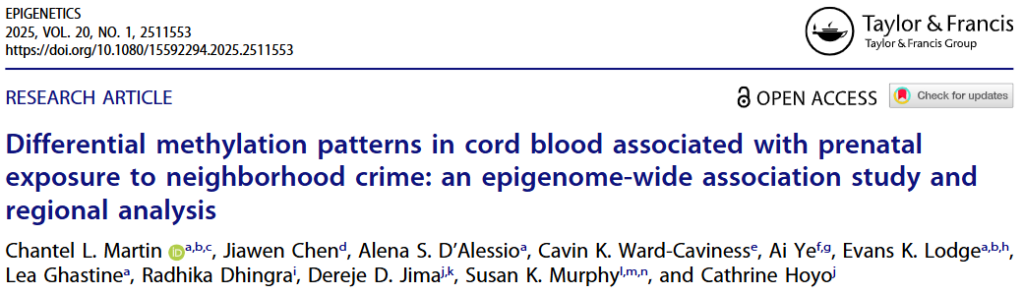
The hypothesis was that higher crime rate would lead to higher stress, which would consequently alter genome-wide methylation patterns in cord blood. Exposure to crime had already been linked to preterm, or early, birth.
I’ll start off by saying that what this study did brilliantly was immediately state that they could find no correlation at the level of the whole epigenome. There is very little incentive for journals to publish negative results, so the authors’ transparency here was really refreshing.
Let’s look smaller
One thing Martin et al. did find, however, were 9 differentially-methylated regions (DMRs), essentially small sites in the genome where methylation was altered when exposed to violent crime.
One in particular was located at a gene called HLA-DPB1. HLAs, or human leukocyte antigens, are human-specific proteins which act a bit like semaphore signals (yep, the thing with the flags) to pass messages between immune cells to ultimately launch immune responses against foreign antigens.
The loss of methylation at HLA-DPB1 may hypothetically suggest increased transcription (note: this was not tested) and a heightened immune response.

The authors interestingly mention that some people with post-traumatic stress disorder (PTSD) also have dysregulated methylation at HLA-DBP1, hinting that its methylation pattern could be impacted by environmental stress.
However, whether this is entirely due to elevated stress because of higher crime exposure, I’m not sure. When pregnant, the mother’s immune system undergoes dramatic modulation to prevent rejecting the foetus (technically 50% foreign material!), which could explain the altered methylation at this gene. Plus, I reckon being pregnant is stressful in itself!
Genes in context
The authors then looked at what biological pathways the genes in these 9 DMRs were involved in using two different methods (this was interesting. Lots of studies only use one).
With Gene Ontology analysis (GO), which categorises genes into a broad function based on previous findings in the literature2, no pathways were found to be statistically significantly altered. What this basically means is that they did not reach the threshold for us to conclude that neighbourhood crime is having a genuine effect on the activity of biological pathways.
However, with KEGG analysis, which looks at genes in the context of biological pathways, they found one hit: the differentially-methylated genes seemed to be involved in differentiation (or specialisation) of Th1 and Th2 cells, which are, again, immune cells, suggesting further that crime exposure may modulate the immune response.
Life is complicated
The limitation with observational studies like this, where authors investigate characteristics from a population without any interference, is that every single mother in that study has their own stresses, their own diets, their own genetics, their own lives.
These are called “confounding factors”, and they cannot be controlled for, since if you tried to stick the 185 pregnant women from this study in an identical environment from the minute of conception to birth, it would more than raise eyebrows from ethics committees.
You can, however, account for them in the statistical analysis3, and this the authors did, including biological factors such as cell type, which in the only other similar study was not controlled for.
Umbilical blood contains numerous white blood cell types, all of which acquire different methylation patterns to express the genes that they need to become, e.g., a T cell. Therefore, whether a methylation mark is just part of the way a cell says “Hiya, I’m a T cell”, or is actually caused by exposure to crime is hard to untangle.
One thing that I feel could be useful to control for is how much time the women spend in the city. For instance, if they worked outside Durham in the first two trimesters, then came home (and stayed home) for most evenings, how much exposure would they really be having to local crime?
“Yeah, and?”
One could argue what the utility of this study is. If we know already that prenatal stress results in lower birth weight and health problems down the line, is there a real need to pin down an epigenetic signature to justify the finding by making it more “biological”?
This is a reason why epigenome-wide association studies (EWAS) like these come under fire, as they seek to find answers in the epigenetic code to complex sociological issues, and obviously separating the two is not that simple. EWAS can often throw up spurious correlations and overstated conclusions.
But I would argue that there is a real need for this type of work, when done properly. Pregnant women are vastly understudied in medicine and biology. Understanding the biology of why and how stress impacts the foetus, and communicating this to pregnant women and their families in an effective and accessible way so they can manage it, could make their lives just that bit easier.
Notes
They did clearly specify that what counted for neighbourhood crime in the study covered burglary, violent crime, and drug-related activity, rather than something like, say, some kids stealing sweets from a corner shop. ↩︎
I have a bit of a gripe with GO analysis. GO terms are manually annotated to genes, meaning they are based off biologists finding papers that say “Gene X may be involved in Y”, and then adding this to the database. The database evolves all the time, which may mean that a very recent paper which says “Gene X is not involved in Y” (which often happens) may be missed out, and lead to misattribution of function. ↩︎
A bit of technicality on how exactly controlling for these things works. Things like maternal smoking, race, educational attainment were controlled in this study. These are termed “covariates”, and the authors estimate how much each one will contribute to the result when doing their statistical analysis. If covariates weren’t included, the bar for a statistically significant result saying “more crime = differential methylation” is a lot lower, making the results less reliable. ↩︎
Discussion point
What communication strategies could we devise to help pregnant women understand the biological impacts of drinking, smoking, etc. during pregnancy?

 The Chromatin Digest
Leave a comment