
The Persistence of Memory by Salvador Dalí. Sourced from brushandbubbles.com under CC BY-NC 4.0.
“Oh Science and Progress! /
You great big wonderful world! Oh what have you done?”
– Sir John Betjeman, 1940
Ever find yourself randomly thinking about an embarrassing memory, something you said or did years ago, and wishing you could forget it entirely? Me too.
For years, there have been clues that epigenetic modifications, particularly histone acetylation and DNA methylation, may help encode memories in specific cells in the brain known as engram cells.
However, it’s been difficult to pin this down to a specific modification or specific site in the genome, and what exactly allows an engram cell to encode memories remained elusive.
Last week, biologists led by Johannes Gräff at EPFL in Switzerland have been able to manipulate memories in mice through controlling the chromatin state of a single promoter in engram cells. Their work is evidence of a direct role of epigenetic modifications in mediating memory and conditioned behaviour.
Moulding chromatin with CRISPR
Gräff’s team selected the Arc promoter, a gene known to be involved in learning, which has a “primed” chromatin state in neurons (essentially, chromatin that’s on the edge of becoming activated; this allowed easier manipulation than a gene that was completely repressed. Imagine trying to drive down a road with roadworks and traffic cones; this is what trying to open blocked-off chromatin is like).
The authors were able to manipulate chromatin at the Arc promoter specifically in engram cells1 by introducing two inducible CRISPR/Cas-9 systems to the mice brains — some mice received a system which would repress Arc and some had one which would activate it.2 Inducible means that the researchers could switch this activation or repression on and off using a specific chemical to trigger it, in this case, doxycycline.
Fear factor
But how did the authors test impacts on memory? After all, it’s not like they could read the minds of the mice in the study.
This was done by a technique called contextual fear conditioning (appropriate for a paper published 2 days before Halloween). Mice received a small electric shock on their foot every 28 seconds in a new cage, therefore learning to associate exploration of the new cage with the shock. They were then brought into another identical cage but received no shocks, and whenever the mouse “froze“, this was considered them linking their environment to fear, i.e. conditioning.3
When Arc was repressed, the mice froze less4, suggesting impairment of memory formation; they hadn’t yet fully learnt to associate the environment with the shock. However, the opposite occurred when Arc was activated — mice froze more often, suggesting memory enhancement.
But what about the “inducible” aspect? I mentioned doxycycline above — treating mice with doxycycline and then removing it could reverse the effects of the CRISPR/Cas-9 system on freezing behaviour, a little like a switch.

A coronal (from the back of the head to the front) section of a mouse brain. From Bmouzon on Wikimedia Commons, under CC BY-SA 4.0.
Confounding variables as far as the eye can see
But how do we know these behavioural changes are down to changing epigenetic modifications at the Arc promoter, and not just, say, a general stress response?
After the behavioural studies, mice brains were harvested (pretty gruesome, I know) for single-cell RNA sequencing (scRNA-seq), which provides a global picture of gene expression in each nucleus, and single cell ATAC sequencing (scATAC-seq), which measures chromatin accessibility at the Arc promoter. Using fluorescence-activated nuclei sorting, they were able to specifically isolate the engram cells for this.
The authors noted that CRISPR-mediated repression decreased transcription from the Arc gene and also physically closed off the promoter, while activation had the opposite effects. They also noted that their scRNA-seq revealed no significant off-target effects, suggesting the changes to fear-related behaviour in the mice were solely due to their manipulation of the Arc promoter in the engram cells, and no other genomic site.
They also ruled out the idea that some mice were naturally more likely to freeze than others.
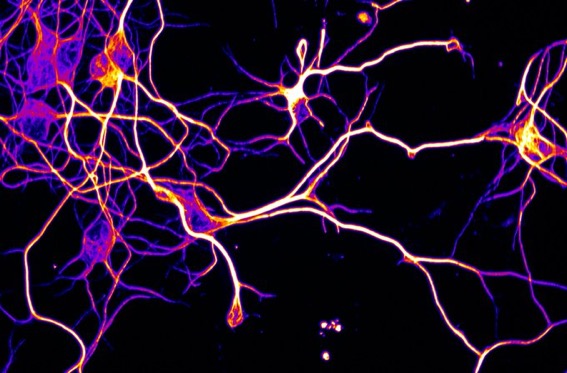
Axons, neuronal projections used for communication, from a mouse brain. From Brian6122 on Wikimedia Commons, under CC BY 4.0.
“Yeah, and?”
It’s quite incredible that scientists were able to modify fear responses through controlling the chromatin promoter of a single region in the mouse genome. This work makes a strong case for the role of epigenetics in memory and behaviour, which is something still viewed with skepticism.
However, I don’t think this technology can be used to make me forget some of the embarrassing things I did when I was younger quite yet 😀
Notes
- They needed to specifically target these cells otherwise the Arc promoter could be manipulated at any and every cell in the brain, not only causing non-specific effects that could muddle the results, but also potentially damaging the health of the mice. ↩︎
- For an explanation of how CRISPR/Cas-9 activation/repression works, see “CRISPRa and CRISPRi” here. In case people are really interested — the authors’ activating system = dead Cas9 fused to VPR or CBP (bunches of transcriptional activators). The authors’ repressive system = dead Cas9 fused to KRAB (a transcriptional repressor) and MeCP2 (which binds to DNA methylation marks, and in turn recruits other proteins to repress gene transcription). ↩︎
- As an aside: to get an accurate measurement of how long the mice froze for, the authors used tiny lasers, which I thought was pretty cool. ↩︎
- Less compared to mice that underwent the same treatment, but used a CRISPR/Cas-9 system that was “non-targeting”, i.e. had no specificity to any genomic promoter, including Arc. ↩︎
Discussion point
Working with mice requires complying with numerous ethical restrictions. Many institutes are trying to limit their use of mouse models to when it’s absolutely necessary. Could we perform similar studies to this in other model organisms, e.g. zebrafish, or even individual cells, and how would this work?

 The Chromatin Digest

Leave a comment