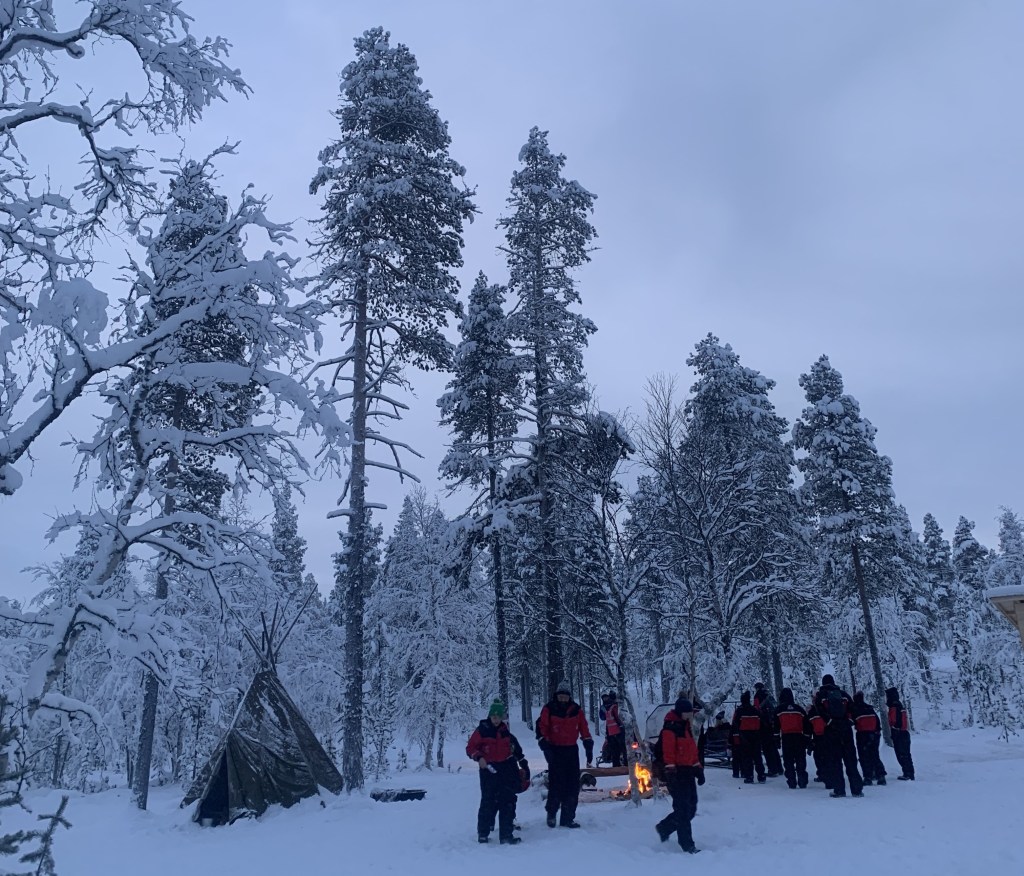
Snow in Finland, 2022. Picture is my own.
If you’re in the UK, you’ve probably noticed the turn in the weather we’ve had recently. Half the trees have shed their autumn leaves, forming dark red blankets across the wet pavements, and if you leave the house without a thick coat, you’ll be confronted by the biting chill that lurks around each street corner. And, of course, it’s also getting darker earlier (which I weirdly quite like. It’s peaceful!).
Cold temperatures and darker days require animals to adapt to keep themselves warm and survive, which has been shown to extend all the way to how DNA organises itself. Let’s take a deep dive into this…
1. The epigenetics of cold exposure: lessons from hibernating animals
It may be no surprise that animals that hibernate are often used to model how cold exposure can alter the epigenome. Many cold-stress studies have been done in squirrels (and also plants!).
One classic study from 2006 highlights how epigenetic readers that are correlated with shutting down transcription, such as histone deacetylases, are upregulated in brown fat tissue in ground squirrels when they are hibernating compared to when they are active. Transcription is expensive in terms of energy costs, and by reducing transcription globally during hibernation, squirrels may use this saved energy to generate heat.1

Franklin’s Ground Squirrel (Spermophilus franklinii). Picture by Ceasol on Wikimedia Commons, under CC BY-SA 3.0.
Since then, more functional studies have been done to investigate the roles of histone deacetylases in heat conservation. By knocking one such enzyme (HDAC3) out of brown fat tissue, mice were less able to tolerate cold temperatures, and their core temperature dropped dramatically even after a few hours.
Enzymes that modulate epigenetic marks therefore seem to be important in allowing mammals to adapt to the cold.
2. The epigenetics of dark exposure: lessons from nocturnal animals
Some of the most interesting work on the epigenetics of low light exposure has come from nocturnal animals, including mice and cats.
In the vast majority of mammalian cells, chromatin is organised into distinct territories called A (active, found in the centre of the nucleus) and B (less active, found at the edges of the nucleus) compartments.
However, there is one notable exception. In the rod photoreceptor cells of most nocturnal animals, which are found in the back of the eye and allow detection of dim light, this organisation is inverted, with A compartments occupying the periphery of the nucleus and B compartments found in the centre:

Polymer model of inverted and conventional chromatin organisation. Green = A (active) compartments; red = B (less active) compartments; blue = “C” compartments (this is a term I’ve not seen before, but in the paper it refers to constitutive heterochromatin, e.g. around nucleoli). Adapted from fig. 5 of Feodorova et al., 2020.
Pushing denser, less active chromatin to the middle of the nucleus allows rod cells to act as mini lenses, collecting and focusing the limited light so the animal can see better in the dark. However, this inverted chromatin may have an evolutionary disadvantage, as it may hinder proper 3D regulation of DNA repair or transcription.
Unfortunately, we don’t know everything about the precise mechanisms that separate out A and B compartments, and in any case, there’s likely more than one factor. So it’s hard to swap A/B compartment organisation back to how it is in most cells to functionally test the “lens” idea.2
“Yeah, and?”
It’s worth noting that all the work on cold exposure has also meant there’s been work on heat exposure too, particularly in the context of chromatin remodelling. This could be really useful in understanding the molecular effects of climate change in the years to come, not only in animals, but humans too.
Notes
- However, I’m not too convinced about a global approach to looking at, say, histone acetylation, if you’re not going to look at specific genes along with it. Transcription could be downregulated at genes that help conserve heat too, and that blows the entire hypothesis out the water. ↩︎
- A wonderful review of inverted chromatin organisation in nocturnal mammals can be found here. ↩︎
Discussion point
Do you think that there are differences between the epigenomes of humans who live in cold, polar climates compared to those in warm, tropical climates? How would you test this?
 The Chromatin Digest

Leave a comment