
Histone modifications and their conventional notation. From Fig. 1 of Turner, 2005.
“Dream of complications / On and on / That’s how my observation tends”
– Interpol, “Complications” off their 2018 album, Marauder
I was reading a paper earlier and the tiniest thing jumped out at me: the histone modification H3K27me3 written inversely as me3K27H3. It’s such a small, insignificant detail, I know, but I did get confused for a second (and it’s genuinely no fault of the authors, by the way, it’s just what I’ve become used to!).
Maybe “me3K27H3” better reflects the way it’s spoken in some of the authors’ first languages, or it’s a lab-specific thing, which would make a lot of sense. But it’s not often you see a term flipped around in a journal article, which often have very strict rules about how they want things written. I’ve also seen it written as trimethH3K27 (OK, I’ll admit, this one just confuses me).
So I got distracted and did some digging, and the commonly accepted way of writing epigenetic marks:
histone protein (H3) -> amino acid (lysine, or K, 27) -> modification (me3)
came from this 2005 paper. But, as you can see, it’s not always rigidly followed, in contrast to fields like chemistry and physics, where the notation is the notation and that’s it. Maybe because the epigenetics field is newer? I’m not entirely sure.
In any case, the conventional notation isn’t without issues. One paper published this year, 20 years on, proves its pitfalls by describing just how maddeningly complicated histone marks are. Genuinely, I had to read this paper in instalments. You can have:
- multiple marks on the same histone tail (H3K27me3, H3K4me3, H3K36me3, etc., which are all on the tail of histone H3).
- Where convention falls short: even though those neighbouring marks can have a big effect on whatever mark you’re studying, you typically only write down the one you’re interested in measuring without clarifying the surrounding environment;
- the same mark on the first or second copy of a histone, or both (there are two copies of each histone, H2A, H2B, H3 and H4, in every nucleosome, the protein blocks that DNA wraps around).
- Where convention falls short: writing “H3K27me3” alone tells you nothing about whether the mark is on the first or second or both, which may be important for structural studies;
- many other conformations.
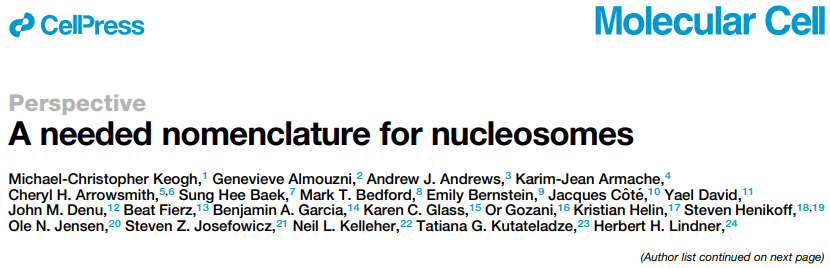
The authors suggest a way of building on the current naming system to incorporate these factors, however, they do note that more detail isn’t always necessary depending on what your experiment is looking at. For example, you wouldn’t search through every book in the library trying to find the one you want, you’d probably just go to a certain section and try to find the author.
I do think a more rigid consensus about the way we write histone marks is important; it massively helps out people reading papers on epigenetics who aren’t in the immediate field. However, there are much more pressing issues in epigenetics (fake news, sensationalisation, amongst others) than how something is written, and as long as it’s recognisable and provides enough accuracy for your experiment, that’s what matters.
Ok, distraction over. I’ll get back to work now!
 The Chromatin Digest
Leave a comment